
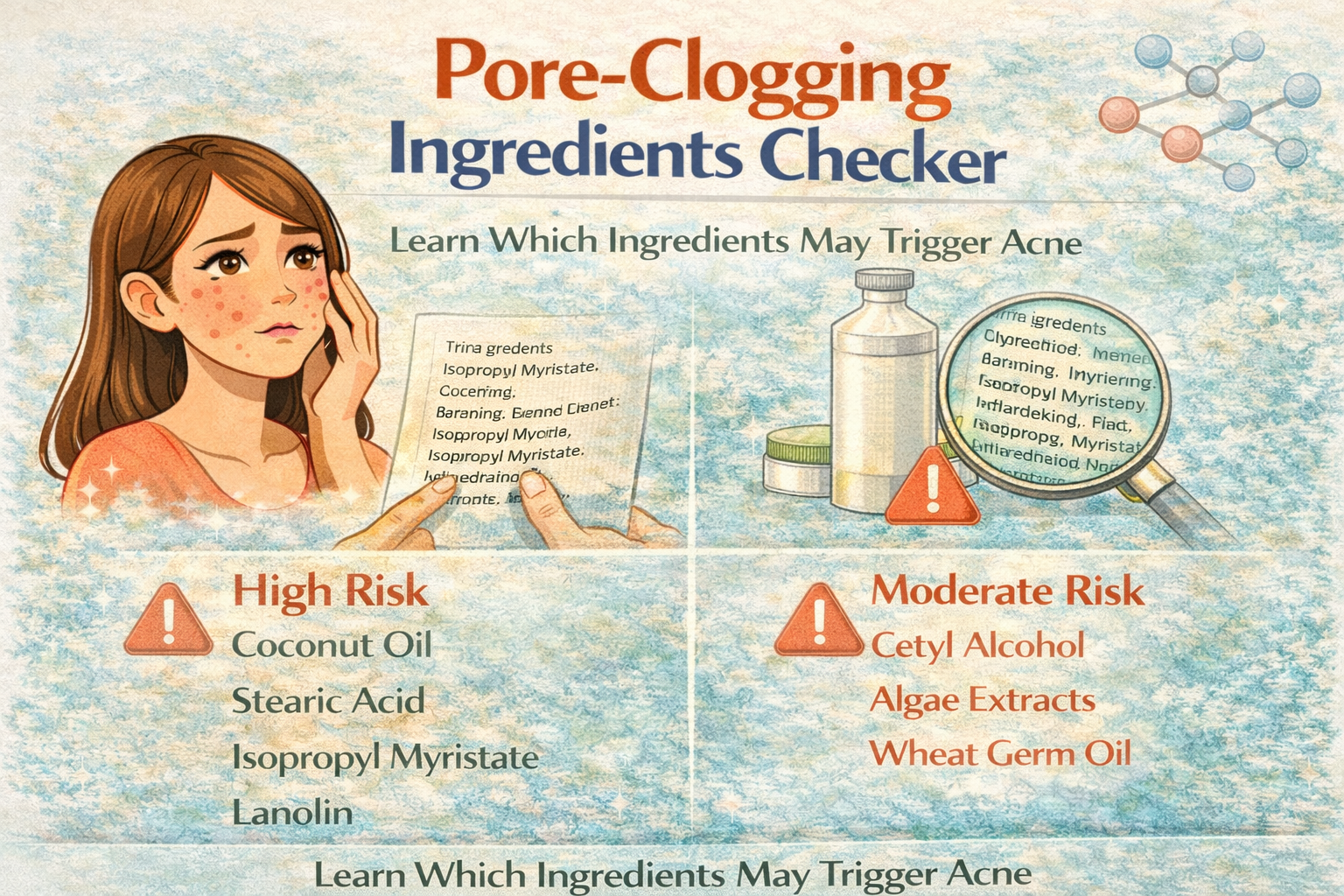
Pore Clogger Checker & List
Instant Pore Clogger Checker (How To Use It Right Away)
- Copy your product’s full ingredient list.
- Paste it into the checker box below.
- Click the “Check Ingredients” button.
- Review the highlighted results to see which ingredients are known to clog pores.
Pore-Clogging Ingredient List
Below is a comprehensive list of common pore-clogging ingredients, organized by type for easier navigation.
Oils and Butters
|
Ingredient Name |
Comedogenic Rating |
|---|---|
|
Coconut Oil |
4-5 |
|
Cocoa Butter |
4 |
|
Wheat Germ Oil |
5 |
|
Flaxseed Oil |
4 |
|
Palm Oil |
4 |
|
Cotton Seed Oil |
3 |
|
Soybean Oil |
3 |
|
Avocado Oil |
3 |
|
Almond Oil |
2 |
|
Olive Oil |
2 |
|
Shea Butter |
0-2 |
|
Mango Butter |
2 |
|
Grapeseed Oil |
1 |
Algae and Seaweed Extracts
|
Ingredient Name |
Comedogenic Rating |
|---|---|
|
Algae Extract |
5 |
|
Carrageenan |
5 |
|
Laminaria Digitata Extract |
4 |
|
Seaweed Extract |
4 |
|
Kelp Extract |
4 |
Esters and Emollients
|
Ingredient Name |
Comedogenic Rating |
|---|---|
|
Isopropyl Myristate |
5 |
|
Isopropyl Palmitate |
4-5 |
|
Myristyl Myristate |
5 |
|
Isostearyl Isostearate |
4 |
|
Isocetyl Stearate |
4 |
|
Butyl Stearate |
3 |
|
Octyl Palmitate |
4 |
|
Octyl Stearate |
4 |
|
Decyl Oleate |
3 |
|
Ethylhexyl Palmitate |
4 |
|
Laureth-4 |
5 |
|
Laureth-23 |
3 |
|
Myristyl Lactate |
4 |
|
Propylene Glycol Monostearate |
4 |
Lanolin-Based Ingredients
|
Ingredient Name |
Comedogenic Rating |
|---|---|
|
Acetylated Lanolin |
4-5 |
|
Acetylated Lanolin Alcohol |
4 |
|
Lanolin |
4 |
|
PEG 16 Lanolin |
4 |
|
Solulan 16 |
4 |
Surfactants and Sulfates
|
Ingredient Name |
Comedogenic Rating |
|---|---|
|
Sodium Lauryl Sulfate |
5 |
|
Sodium Laureth Sulfate |
3 |
|
Laureth-4 |
5 |
|
Laureth-23 |
3 |
|
Oleth-3 |
4 |
|
Polysorbate 60 |
4 |
Other Common Pore Cloggers
- D & C Red Dyes (e.g., D&C Red 30, D&C Red 36)
- Sodium Chloride (Salt)
- Hexadecyl Alcohol
- Myristic Acid
- Stearic Acid
- Cetyl Acetate
- Isopropyl Isostearate
- Isopropyl Lanolate
- Isopropyl Linoleate
- Isopropyl Oleate
- Isopropyl Palmitate
- Isopropyl Stearate
- Myristyl Lactate
- Myristyl Myristate
- Octyl Palmitate
- Octyl Stearate
- Propylene Glycol Monostearate
- Sodium Laureth Sulfate
- Sodium Lauryl Sulfate
- Stearyl Heptanoate
- Xylene
Frequently Asked Questions
What is a comedogenic ingredient?
A comedogenic ingredient is one that is likely to clog pores and contribute to acne or breakouts, especially for those with sensitive or acne-prone skin.
How accurate is the Pore Clogger Checker?
The checker uses a comprehensive, research-backed database of comedogenic ratings, but individual reactions may vary. Always patch test new products.
Can I use this checker for all skincare and makeup products?
Yes, you can use the checker for any product with a full ingredient list, including cleansers, moisturizers, sunscreens, and makeup.
References
- Comedogenic Ratings Database
- Dermatology Research on Acne-Causing Ingredients
- Ingredient Safety Resources
Instant Pore Clogger Checker (How To Use It Right Away)
This page helps you quickly spot pore clogging ingredients in any skincare, haircare, or makeup product. Whether you’re dealing with stubborn breakouts or just want to audit your routine, the tool below identifies known pore cloggers in seconds.
Here’s how to use the pore clogger checker:
- Google your product name + “ingredients”: Search for the exact product (e.g., “CeraVe Daily Moisturizing Lotion ingredients”) to find the full ingredient list on the brand site or a retailer like Ulta or Sephora.
- Copy the full INCI ingredient list: Highlight and copy the entire list exactly as shown. Don’t worry about commas or line breaks—the tool handles formatting automatically.
- Paste the list into the checker box below: Use the text field to paste your ingredient list. The tool accepts lists with commas, line breaks, or mixed formatting.
- Click “Check for Pore Cloggers”: Hit the button and wait a few seconds for your results.
The tool highlights any known comedogenic ingredients in red and returns a short risk summary (low, moderate, or high pore-clogging potential). You’ll see exactly which ingredients might be causing problems and why.

What Is a Pore Clogger Checker?
A pore clogger checker is an online ingredient checker that compares a product’s ingredient list against a curated database of comedogenic substances. Think of it as a quick scan that flags anything likely to clog pores before you apply it to your face.
The checker is designed primarily for people with acne prone skin, but anyone can use it to double check their routine. If you’ve ever had blackheads, whiteheads, or unexplained congestion, this tool helps you identify potential culprits hiding in your products.
The database behind this pore clogging ingredient checker draws from:
- Published comedogenic ratings on the 0–5 scale dating back to research from the 1970s and 1980s
- Cosmetic chemistry references and formulation analysis
- Acne-specialist clinic experience spanning decades
- Updated entries reflecting 2023–2025 ingredient trends
This tool doesn’t diagnose medical conditions. It flags ingredients that are more likely to contribute to clogged pores when used in leave-on products.
Key benefits of using a pore clogger checker:
- Instant ingredient analysis without manual research
- Brand-neutral assessment (no marketing bias)
- Coverage across skincare, makeup, and hair products
- Identifies specific problem ingredients rather than vague warnings
How the Pore Clogger Checker Works
When you paste an ingredient list into the tool, here’s what happens behind the scenes:
The checker breaks down your pasted list into individual ingredients, cleaning up spelling variations, extra spaces, and formatting inconsistencies. Each item is then matched against an internal database of known pore cloggers and acne safe ingredients.
What you’ll see in your results:
- Comedogenic rating (0–5) — A number indicating pore-clogging potential, where 0 means unlikely to clog and 5 means highly likely
- Color codes — Green for safe, yellow for moderate concern, red for high-risk
- Brief explanations — A short note on why the ingredient is flagged (e.g., “heavy ester that can trap oil and debris in pores”)
The tool categorizes flagged ingredients into three groups:
|
Category |
What It Means |
|---|---|
|
High-risk pore clogger |
Rated 4–5; frequently linked to breakouts in acne prone individuals |
|
Moderate concern |
Rated 2–3; may cause issues depending on concentration and skin type |
|
Typically safe |
Rated 0–1; unlikely to clog pores for most people |
Important note: The checker focuses on leave-on formulas—moisturizers, primers, foundations, sunscreens, and hair styling products that touch your face. Rinse-off products like cleansers and shampoos pose less risk since they don’t stay on the skin long enough to penetrate pores.
Example scan:
Imagine pasting this ingredient list from a 2024 drugstore moisturizer:
Water, Glycerin, Dimethicone, Cetyl Alcohol, Isopropyl Myristate, Stearic Acid, Tocopheryl Acetate, Phenoxyethanol
The checker would highlight Isopropyl Myristate in red (rated 5) while showing Dimethicone and Cetyl Alcohol as green (rated 0–1). You’d immediately know which ingredient to watch for if this product causes breakouts.
Common Pore-Clogging Ingredients to Watch For
Some ingredients repeatedly show up in breakout-prone clients’ routines, and the checker is specifically tuned to catch these. Below are the most common offenders grouped by category.
Heavy Oils and Butters
These ingredients provide rich moisturization but can overwhelm acne prone skin:
- Coconut oil (cocos nucifera oil): Rated 4; one of the most notorious pore cloggers despite its popularity
- Coconut butter: Similar concerns to coconut oil
- Wheat germ oil: Rated 5; extremely comedogenic despite being “natural”
- Cotton seed oil: (sometimes listed as cotton awws oil in databases) Rated 3
- Soybean oil: Rated 3; common in “clean beauty” products
- Corn oil: Rated 3
- Cocoa butter: Rated 4; problematic in thick creams
- Shark liver oil: Rated 3
- Shea butter: Debated; rated 0–2 depending on source, but can contribute to congestion in some users
Algae and Seaweed Extracts
Natural doesn’t mean safe for pores. Watch for:
- Carrageenan: (aka irish moss, carageenan moss, chondrus crispus) Rated 5
- Laminaria saccharina extract: (also listed as laminaria saccharine) Rated 5
- Laminaria digitata extract: Rated 5
- Irish moss: Rated 5
- Gelidiella acerosa extract gelidium: Rated 5
- Duodecylic acid durvillaea antarctica: Check ratings carefully
Comedogenic Esters and Emollients
These create smooth textures but often trap sebum:
- Isopropyl myristate: Rated 5; extremely common in foundations and primers
- Isopropyl palmitate: Rated 4
- Ethylhexyl palmitate: Rated 4
- Isocetyl stearate: Rated 4
- Isostearyl isostearate: Rated 4–5
- Myristyl myristate: Rated 5
- PPG 2 myristyl propionate: (sometimes listed as ppg 2 myristyl) Rated 5
- Propylene glycol monostearate: Rated 3
- Butyl stearate: Rated 3
- Cetyl acetate: Rated 4
- Glyceryl 3 diisostearate: Rated 4
- Isocetyl alcohol: Rated 4
-
Hexadecyl alcohol: Rated 2
Lanolin-Based and Wax-Like Ingredients
Common in thick creams, lip products, and makeup:
- Acetylated lanolin: Rated 4
- Acetylated lanolin alcohol: Rated 4
- Lanolin alcohol: Rated 2
- PEG 16 lanolin: Rated 4
- Coal tar: Rated 3–4
Surfactants and Sulfates
These can irritate and contribute to congestion:
- Sodium lauryl sulfate: (sodium lauryl) Known irritant that can disrupt skin barrier
- Sodium laureth sulfate: Milder but still potentially problematic
- Sulfated jojoba oil: Rated 3
- Sulfated castor oil: Rated 3
- PEG 2 sulfosuccinate: Check ratings
- Disodium monooleamido: Monitor for sensitivity
Problematic Fatty Acid and Emulsifier Blends
Some combinations create more issues than single ingredients:
- Cetearyl alcohol ceteareth 20: This combination can be more problematic for acne prone skin than cetearyl alcohol alone
- Stearic acid tea: (stearic acid with triethanolamine) Rated 3
- Lauric acid: Rated 4
- Stearic acid: Rated 2–3 depending on formulation
- Wheat germ glyceride: Rated 4
- Hydrogenated vegetable oil: Rated 3
- Castor oil: Rated 1 (generally safer)
- Propylene glycol: Rated 0–1 (usually safe but can cause sensitivity)
The checker is updated regularly as new formulating trends in 2023–2025 introduce novel esters, plant oils, and synthetic alternatives. An ingredient considered “safe” five years ago may now have more data suggesting otherwise.
How to Read Your Results and What to Do Next
After running your ingredient list through the checker, here’s what you’ll see and how to act on it.
Results layout:
- Risk summary: A quick assessment at the top (e.g., “High pore-clogging potential — 3 flagged ingredients”)
- Flagged ingredient list: Each problem ingredient with its rating, color code, and explanation
- Next steps box: Personalized recommendations based on your results
Interpreting your results:
- If multiple red-flag pore clogging ingredients appear near the top of the ingredient list, they’re present in higher concentrations. For acne prone skin, strongly consider replacing that product.
- Moderate-risk ingredients toward the end of the list (after the first 10–15 ingredients) are present in lower amounts and might be tolerated by some people.
- A single yellow-rated ingredient doesn’t automatically mean you need to stop using a product context matters.
Products to check:
Don’t limit your scan to just moisturizers. Check everything that touches breakout-prone areas:
- Facial moisturizers and night creams
- Sunscreens (especially chemical formulas)
- Foundations, BB creams, and tinted moisturizers
- Primers and setting sprays
- Liquid and cream blush, bronzer, and highlighter
- Concealers
- Leave-in conditioners and hair serums
- Beard oils and styling products that contact the face
Real-world example:
Consider a 22-year-old with persistent jawline acne who has tried “everything.” She runs her “non comedogenic” 2023 foundation through the checker and discovers isopropyl myristate and coconut oil listed in the top eight ingredients. Despite the marketing claims, her daily foundation has been feeding her breakouts for months.
Action steps after flagging a problematic product:
- Remove the product from your routine for 2–4 weeks and observe your skin
- Find products that are oil free or specifically formulated without high-comedogenic ingredients
- Introduce new “clean” products one at a time
- Wait 2–4 weeks between adding new products to see which changes actually help
- Keep a simple log of what you’re using and how your skin responds
Pore Clogger Checker vs. “Non-Comedogenic” Labels
Here’s an uncomfortable truth: “non comedogenic,” “acne safe,” and “won’t clog pores” are marketing terms. In most countries, including the United States, these claims aren’t regulated by any governing body.
This means:
- Products launched as recently as 2022–2024 can contain classic pore clogging ingredients yet still carry “non-comedogenic” labels
- Brands can run minimal or no testing before making these claims
- There’s no standardized definition of what “non-comedogenic” actually means
- The label might be based on the finished product’s performance, but formulation changes between batches aren’t always retested
The checker’s advantage:
Unlike vague product claims, the pore clogger checker uses a transparent, ingredient-level approach. You can see exactly which components are flagged and why, rather than trusting a marketing term on the front of the package.
Always cross-check any “acne safe” or “non-comedogenic” product in the pore clogger checker before purchasing or using it consistently. The five minutes you spend now can save weeks of unexplained breakouts.
A balanced perspective:
A single potentially comedogenic ingredient doesn’t doom a product for everyone. Some people with oily skin break out from coconut oil immediately, while others with dry skin tolerate it fine. However, patterns of several high-risk ingredients, especially near the top of the list, should raise concern for anyone with acne prone skin.
Limitations, Safety Tips, and When to See a Professional
The pore clogger checker is an educational tool designed to help you make more informed product choices. It’s not a substitute for professional medical advice, especially if you’re dealing with severe or persistent acne.
Understanding the tool’s limitations:
- Most comedogenicity ratings trace back to the 1979 rabbit ear test, where ingredients were applied to rabbit ears (a highly sensitive model) and observed for pore blockage
- These tests don’t perfectly translate to every human skin type, ethnicity, age group, or climate
- The way an ingredient behaves depends on its concentration, the overall formulation, and other ingredients it’s combined with
- A substance rated “3” might be perfectly fine at 0.5% concentration but problematic at 5%
Factors beyond ingredients:
Your skin’s behavior in 2024–2025 is influenced by much more than just what you apply topically:
- Hormonal fluctuations (menstrual cycle, pregnancy, perimenopause)
- Diet and gut health
- Medications (oral contraceptives, spironolactone, isotretinoin, antibiotics)
- Stress levels and sleep quality
- Climate and humidity changes
- Pillowcase and phone cleanliness
Safety recommendations:
- Patch test new products, especially those containing strong actives like retinoids, benzoyl peroxide, AHAs, or BHAs, even if they score as “low pore-clogging”
- Don’t overhaul your entire routine at once based on checker results
- Give changes 4–8 weeks before evaluating whether they’re helping
When to see a professional:
Consider booking an appointment with a dermatologist or licensed esthetician if:
- Your acne is painful, deep, or cystic
- You’re experiencing scarring or post-inflammatory hyperpigmentation
- Breakouts haven’t improved after 8–12 weeks of using low-comedogenic products
- You suspect hormonal acne (deep cysts along the jawline and chin)
- Over-the-counter treatments aren’t making a difference
- You’re considering prescription options like tretinoin, spironolactone, or isotretinoin
Key Takeaways
- A pore clogger checker scans your product’s full ingredient list against a database of known comedogenic substances, flagging anything that might clog pores
- Common culprits include coconut oil, isopropyl myristate, wheat germ oil, acetylated lanolin, and certain algae extracts like laminaria saccharina extract and irish moss
- “Non comedogenic” labels aren’t regulated—always copy and paste the ingredient list into a checker to verify claims
- Focus on leave-on products that stay on your skin: moisturizers, sunscreens, foundations, and hair products that touch your face
- Introduce changes one product at a time and give your skin 2–4 weeks to respond
- The checker is a helpful screening tool, but persistent or severe acne requires professional evaluation
Start Auditing Your Routine
A pore clogger checker won’t solve every skin concern, but it gives you essential information that marketing labels won’t. Armed with ingredient-level insights, you can make smarter choices about what goes on your face.
Start by checking the products you use most often, your daily moisturizer, foundation, and sunscreen. These three touch your skin for hours every day and are the most likely contribute to ongoing congestion if they contain pore cloggers.
If you find products with multiple red-flag ingredients, don’t panic. Swap them out one at a time, track how your skin responds, and build a routine that actually works with your skin instead of against it. And if breakouts persist despite cleaning up your products, that’s your signal to consult a dermatologist who can address factors beyond what any ingredient checker can detect.
- Learn more about what causes acne
Medical Disclaimer
This article is for informational purposes only and does not substitute professional medical advice. Always consult a qualified healthcare provider before starting supplements or changing medical treatment. These statements have not been evaluated by the Food and Drug Administration. This product is not intended to diagnose, treat, cure, or prevent any disease.


